Understanding The Moon Phases
Have you ever wondered what causes the moon phases? We all know that
its appearance changes over time. But why? The good way to understand
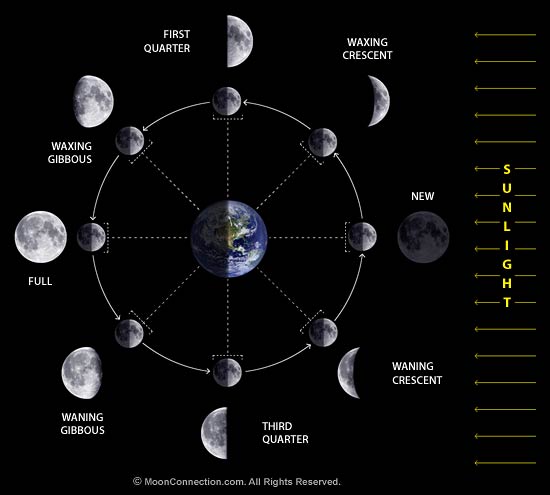
the phases of the moon is to examine an earth-moon-sun diagram:
©MoonConnection.com
All Rights Reserved. This moon phases diagram is NOT public domain and
may not be used on websites, copied, printed or republished except by
permission.
Diagram Explanation
The illustration may look a little complex at first, but it's easy to explain.
Sunlight is shown coming in from the right. The earth, of course, is at
the center of the diagram. The moon is shown at 8 key stages during its
revolution around the earth. The moon phase name is shown alongside the
image. The
dotted line from the earth to the moon represents your line of sight
when looking at the moon. To help you visualize how the moon would
appear at that point in the cycle, you can look at the larger moon
image.
This means for the waning gibbous, third quarter, and waning crescent phases you have to mentally turn yourself upside down. When you do this, you'll "see" that the illuminated portion is on your left, just as you see in the large image.
One important thing to notice is that exactly one half of the moon is
always
illuminated by the sun. Of course that is perfectly logical, but you
need to visualize it in order to understand the phases. At certain times
we see
both the sunlit portion and the shadowed portion -- and
that creates the various moon phase shapes we are all familiar with.
Also note that the shadowed part of the moon is invisible to the naked
eye; in the diagram above, it is only shown for clarification purposes.
So the basic explanation is that the lunar phases are created by
changing angles (relative positions) of the earth, the moon and the sun,
as the moon orbits the earth.
If you'd like to examine the phases of the moon more closely, via computer software, you may be interested in this
moon phases calendar software.
Moon Phases Simplified
It's probably easiest to understand the moon cycle in this order: new
moon and full moon, first quarter and third quarter, and the phases in
between.

As shown in the above diagram, the
new moon occurs when the moon is positioned
between
the earth and sun. The three objects are in approximate alignment (why
"approximate" is explained below). The entire illuminated portion of the
moon is on the back side of the moon, the half that we cannot see.
At a
full moon, the earth, moon, and sun are in approximate
alignment, just as the new moon, but the moon is on the opposite side of
the earth, so the entire sunlit part of the moon is facing us. The
shadowed portion is entirely hidden from view.
The
first quarter and
third quarter moons (both often called a "
half moon"),
happen when the moon is at a 90 degree angle with respect to the earth
and sun. So we are seeing exactly half of the moon illuminated and half
in shadow.
Once you understand those four key moon phases, the phases between
should be fairly easy to visualize, as the illuminated portion gradually
transitions between them.
An easy way to remember and understand those "between" lunar phase names
is by breaking out and defining 4 words: crescent, gibbous, waxing, and
waning. The word
crescent refers to the phases where the moon is
less that half illuminated. The word
gibbous refers to phases where the moon is
more than half illuminated.
Waxing essentially means "growing" or expanding in illumination, and
waning means "shrinking" or decreasing in illumination.
Thus you can simply combine the two words to create the phase name, as follows:
After the new moon, the sunlit portion is increasing, but less than half, so it is
waxing crescent. After the first quarter, the sunlit portion is still increasing, but now it is
more than half, so it is
waxing gibbous. After the full moon (maximum illumination), the light continually decreases. So the
waning gibbous phase occurs next. Following the third quarter is the
waning crescent, which wanes until the light is completely gone -- a new moon.
The Moon's Orbit
You may have personally observed that the moon goes through a complete
moon phases cycle in about one month. That's true, but it's not exactly
one month. The
synodic period or
lunation is exactly 29.5305882 days. It's the time required for the moon to move to the same position (same phase)
as seen by an observer on earth.
If you were to view the moon cycling the earth from outside our solar
system (the viewpoint of the stars), the time required is 27.3217 days,
roughly two days less. This figure is called the
sidereal period or
orbital period.
Why is the synodic period different from the sidereal period? The short
answer is because on earth, we are viewing the moon from a moving
platform: during the moon cycle, the earth has moved approximately one
month along its year-long orbit around the sun, altering our angle of
view with respect to the moon, and thus altering the phase. The earth's
orbital direction is such that it lengthens the period for earthbound
observers.
Although the synodic and sidereal periods are exact numbers, the moon
phase can't be precisely calculated by simple division of days because
the moon's motion (orbital speed and position) is affected and perturbed
by various forces of different strengths. Hence, complex equations are
used to determine the exact position and phase of the moon at any given
point in time.
Also, looking at the diagram (and imagining it to scale), you may have
wondered why, at a new moon, the moon doesn't block the sun, and at a
full moon, why the earth doesn't block sunlight from reaching the moon.
The reason is because the moon's orbit about the earth is about 5
degrees off from the earth-sun orbital plane.
However, at special times during the year, the earth, moon, and sun do
in fact "line up". When the moon blocks the sun or a part of it, it's
called a
solar eclipse, and it can only happen during the new moon phase. When the earth casts a shadow on the moon, it's called a
lunar eclipse,
and can only happen during the full moon phase. Roughly 4 to 7 eclipses
happen in any given year, but most of them minor or "partial" eclipses.
Major lunar or solar eclipses are relatively uncommon.
Moon Software
If you want to follow the phases of the moon, you should definitely take a look at
QuickPhase Pro,
our flagship moon software product for your personal computer. This
attractive and fun software covers thousands of years of past and future
moon phases and is easy to use.


